
Planting Roots
Mon Jun 15 2026
Jess Morton
hello forest dwellers…
Today’s post will be a bit of a past-present-future experience. We’ll look at the last 6 weeks of progress since the first blog post, where this has lead me structurally and philosophically with my approach, and situated in this, what my goals are now, short and long term.
Brief sidenote: Once I establish more regular posting, I hope this recent break will come to seem uncharacteristically long. I intend to post an update on the 1st and 15th of each month (as a minimum) moving forward :)
T-45 Days to Now
When I wrote the first blog post, I was in my last couple weeks of college, which was… a very intense grind at the end of a year of many intense grinds. I was sufficiently ground down when all was said and done.
This is to say, my mind, body, and soul needed a #UncharacteristicallyLongBreak. I was also dabbling with a new ADHD medication that caused some annoying waves of fatigue for most of May, and also ended up not working…
With that said, I do have a few joys to announce. The website has seen major improvements (there was no blog a month ago), the hardware has changed to be significantly cheaper and more in-line with standard IoT development, and I’ve talked with many people about the shape of the project, leading me to think of it in sort of a whole new light.
Let’s get a bit more into these changes.
Major Changes
Here are the major technical changes over the last month or so
1. The hardware component of the project used to be a Raspberry Pi, but at this point I’m fairly confident I want it to be done using a microcontroller, such as an STM32. They are significantly cheaper and more efficient, as well as being ubiquitous in the IoT space, a domain I want to learn more in. This means I’ll be writing firmware instead of a server process, which is… new to me! But I’m excited to learn how it’s done.
2. I’m calling the hardware component an access point, not a gateway. Each node serves as a direct entry into the mesh, and doesn’t mediate passage between WAN and LAN like traditional IPv4 gateways, so access point makes more sense.
3. The access point is now largely independent from the person who sets it up/the client using it. Each AP will authenticate with the client trying to use it, and only the person who set up the node, the admin, will be able to modify the files contained on it. All other users have the priveleges associated with their account for any given Mori web service they’re using. This makes it so relays can be set up easily, but new file distribution only occurs from gateways with active admins.
4. I’m 90% sure I’ll be developing the client software with Tauri, a Rust-powered app development framework that uses React. I have a lot of experience with React, and Tauri bundles are cross-platform and much lighter than Electron.
There’s another group of changes too, those having to do with my conception of the project and what I see the primary use case to be.
1. Mori has some intersting connections to cellular networks. Instead of your phone being mobile, you choose where to plant it and then it becomes its own cell tower, growing the range of the network. It’s an inter-tower communication system, which makes since given the flat nature of the mesh. The distinction between communication device and infrastructure, between phone and tower, dissolves into a single thing (the access point).
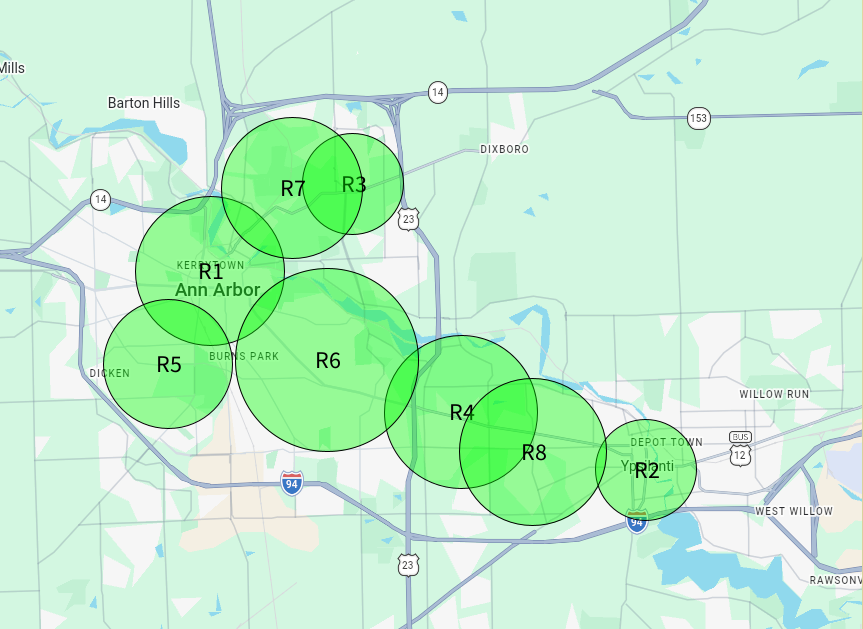
Each circle here is an access point. Being inside of any of these green circles means that you have complete access to all nodes that have an unbroken path to it. Coverage is a public resource provided by each node, an area-of-effect that can bridge between peers and give them direct contact with you.
2. Mori can serve as a plug-and-play, portable web solution for anyone wanting local web communication. If you have a group of friends spread across town who can form a continous network path, that’s enough to make a local, off-grid web with Mori. The web protocol should be flexible enough to allow a variety of types of interaction (file sharing, direct messaging, forums). It has the vibe of walkie-talkies, except if walkie talkies could relay message between each other and offered a full web experience, not just real-time audio.
3. A bit more on this plug-and-play idea: with Mori, I’m really excited at the idea of democratizing the web and creating an open source framework for people to build their own infrastructure for digital community-building. Existing options for owning your access to the web don’t exist. It’s largely unprecedented, and it’s something I think a lot of people would get good use out of (including me!).
4. I become more and more convinced of the benefits of having a smaller, more local internet, and intend to write about this at length in the philosophy section of the website very soon.
Looking Ahead
If it hasn’t hit you yet, this project is pretty freaking big, though a minimal, proof-of-concept version shouldn’t be too hard to implement. This is what I want to finish before the end of the summer, and before I start accepting contributors.